
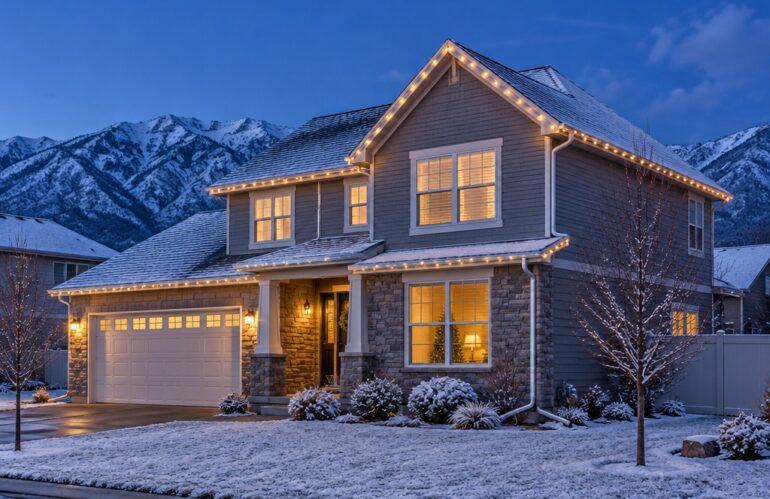
Most guides to how to hang christmas lights on roof lines were written somewhere without a real winter. Along the Wasatch Front the lights go up in the last mild week of November, then spend six weeks under snow load, sliding snow, and ice at the eaves. The goal is not just lights that stay up. It is lights that come down in January without taking a shingle, a gutter hanger, or a section of drip edge with them.
QUICK ANSWER
Hang Christmas lights on a roof with plastic clips that slide under shingle edges or grip the gutter lip, never with nails, staples, or screws, since every hole is a potential leak. Work from a stable ladder, keep strands out of valleys where snow and meltwater collect, and plug outdoor-rated lights into a GFCI outlet.
The four clip types, and where each one belongs
All of these cost a few cents each and all of them are reusable. Buy more than you think you need, because the right answer on most houses is a mix rather than one type everywhere.
- Shingle tabs. A flat plastic hook that slides up under the bottom edge of a shingle course and holds the strand below it. The best option for a roofline with no gutter, and the one to use along a gable rake. Slide, never force: if a shingle resists, it is cold and brittle, and pushing harder cracks it.
- Gutter hooks. An S-shaped or C-shaped clip that grips the outer lip of the gutter. Fast, invisible from the ground, and it keeps every fastener off the roof surface entirely. This is the default choice anywhere you have gutters.
- All-in-one clips. One clip with a shingle tab, a gutter notch, and usually a C9 bulb slot. Worth the small premium so you are not swapping hardware halfway along a run.
- Ridge and peak clips. A longer clip designed to straddle the ridge cap for a strand running along the top of the roof. Use sparingly in this climate. A ridge run means walking the roof, and it sits exactly where snow builds deepest.
Space clips every 12 inches along the eave and tighten to 8 inches at corners, where wind gets under a strand. Our rundown of the parts of a roof names each edge.
Why nails, staples, and screw-in hooks cause leaks
This is the one rule with no exceptions. Every fastener driven through a shingle, a fascia board, or a piece of drip edge creates a hole, and a hole on a roof is only ever temporarily dry.
A staple through a shingle in November is under snow by December. Meltwater running down the slope reaches that puncture, sits there because the eave below it is frozen, and works through. The leak does not appear that week. It appears in February as a stain on an upstairs ceiling, and by then nobody connects it to the lights. We see this every spring, and the repair costs many times more than a bag of clips.
Staple guns are the worst offender, because the staple is nearly invisible once it is in, so it never gets removed and the holes accumulate year after year. Screw-in cup hooks split fascia and sit right where gutter overflow runs. Our explainer on roofing flashing covers why the roof edge is the least forgiving place on the house to put a hole.
Metal roofs: clips that need no drilling at all
Never drill a metal roof for lights. On a standing seam panel a single penetration compromises both the waterproofing and the panel’s ability to expand and contract, which it does constantly through a Utah winter. Two options avoid it completely.
- Magnetic clips. They hold well on steel panels and need nothing but a clean surface. They do not work on aluminum or copper, so test one before you buy a hundred. Wipe the panel first, since grit under a magnet scratches the finish.
- Seam clamps. Small clamps that grip the raised seam of a standing seam roof with a set screw that bears on the seam itself, never through the panel. These are the same principle as snow guards and they are the strongest option available.
- Adhesive clips. A last resort. Cold weather ruins the bond and removal in spring frequently takes finish off with it.
One point specific to metal: it sheds snow in slabs rather than melting it off gradually, so anything clipped to that slope gets hit by moving snow. Keep strands on the gutter and off the panel where you can. Our metal roofing page covers how these roofs behave in snow.
Gutter guards, and houses with no gutters at all
If you have gutter guards
Standard gutter hooks will not reach past a guard to grip the lip. What works depends on the guard style. Reverse curve and solid covers usually leave the outer gutter lip exposed, so a deeper C-style hook still catches it. Micro-mesh and screen guards sit flush and cover the lip entirely, which leaves you two options: clips made to sit on top of the guard surface, or switching to shingle tabs on the course above and skipping the gutter altogether. Do not pry up a guard to slip a hook underneath. You will bend the edge and create exactly the gap that lets debris in.
If you have no gutters
Shingle tabs along the bottom course are the answer, and they work well. The thing to watch is where the water goes once the snow starts melting, because a roof with no gutter dumps its entire runoff load in a line along the drip line. Keep extension cords and connections out of that line and off the ground beneath it. If the reason you have no gutters is that nobody has gotten around to it, see our gutter installation page: in a freeze and thaw climate that runoff is doing real work on your foundation every spring.
Ladder safety, and when to skip the roof entirely
Falls from ladders spike every December, and almost all of them happen on the day someone decided it would only take a minute.
- Set the ladder at the right angle. One foot of base distance for every four feet of height, on firm level ground, with three feet extending above the eave.
- Never set a ladder on snow, ice, or frozen grass. Frozen ground looks solid and gives the moment the feet bite. Clear a patch to bare pavement or use a stabilizer.
- Stay centered, and move the ladder rather than reaching. Leaning sideways is how ladders kick out.
- Use a standoff. A ladder resting on a gutter bends it and loosens the hangers.
- Have someone with you, so somebody knows you are up there.
Then the harder judgment: skip it and hire someone if the roof is steep, two stories or more, wet or frosted, or if you would have to walk the surface to reach the run. Nothing about a light display is worth a fall.
Taking them down without cracking a shingle
Removal is where most of the damage actually happens, because asphalt shingles turn brittle in the cold. The same shingle that flexed easily in November will snap at 25 degrees.
- Wait for a warm, dry afternoon. Above 40 degrees if you can get it, with the roof fully dry. There is no prize for taking lights down on January 2nd.
- Unclip, do not pull. Yanking a strand drags every clip along the shingle edge at once. Release each clip by hand along the run.
- Leave a frozen clip alone. If a clip is iced to the roof, come back another day. Forcing it takes granules, and granule loss is how a roof ages early.
- Count what comes down. A clip left behind spends a year in the gutter and ends up in a downspout.
While you are up there, look. Lifted or cupped shingles, granule buildup in the gutter, a sagging run, soft or stained fascia, or a gap where the drip edge has pulled away are all worth addressing before the next storm rather than after. If something is actively leaking, our roof leak repair and emergency roof repair teams cover Weber, Davis, Morgan, and Summit counties.
Schedule a Roof Check Before the Next Storm
Frequently Asked Questions
How do you hang Christmas lights on a roof without nails?
Use plastic clips. Shingle tabs slide under the bottom edge of a shingle course, and gutter hooks grip the outer lip of the gutter. Both hold a strand securely with no fasteners, no holes, and no adhesive, and both are reusable for years.
How do you hang Christmas lights with gutter guards?
It depends on the guard. Reverse curve and solid covers usually leave the outer gutter lip exposed, so a deeper C-style hook still grips. Micro-mesh and screen guards cover the lip, so use clips made to sit on the guard surface, or switch to shingle tabs on the course above.
How do you hang Christmas lights on a metal roof?
With magnetic clips on steel panels or seam clamps on standing seam, never by drilling. A single penetration in a metal panel compromises the waterproofing and the panel’s ability to expand and contract through winter temperature swings.
How do you hang Christmas lights on a roof without gutters?
Shingle tabs along the bottom shingle course, spaced about every 12 inches and tighter at corners. Slide each clip under the shingle edge rather than forcing it, since cold shingles crack under pressure.