
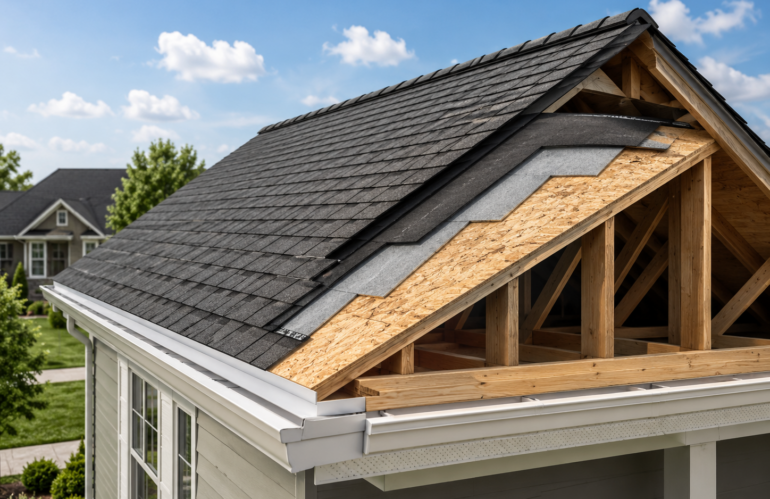
Your roof is not a single thing. It is a layered system — roughly eight distinct components working in sequence to shed water, resist wind, regulate temperature, and protect everything below. When one component fails, the others compensate until they cannot.
Understanding the parts of a roof is not just useful trivia. It is how you follow along when a contractor explains what they found, recognize when an estimate includes something suspicious, and make sense of what your insurance adjuster is actually talking about.
Here is every major component, what it does, and what happens when it stops doing it.
What are the main parts of a roof?
The main parts of a roof include the structural layer (rafters or trusses and decking), the waterproofing layer (underlayment, shingles, and flashing), the edge and drainage system (drip edge, gutters, fascia, and soffit), and the ventilation system (ridge vents and soffit vents). Each component performs a specific role, and they work together as an integrated system.
The Structural Layer: What Holds Everything Up
Before a single shingle goes on, the roof needs a skeleton.
Roof Trusses and Rafters
Trusses and rafters are the framing — the triangular or sloped structural members that give the roof its shape and bear its weight. In most homes built after the 1970s, factory-engineered trusses have replaced traditional rafter systems. Both do the same job: transfer the load of the roof down into the walls and foundation.
When you hear about structural roof damage after a major storm, this is what is at risk. Sagging ridgelines, bowing ceilings, and doors that suddenly stick can all signal truss or rafter stress.
Roof Decking (Sheathing)
Decking is the plywood or OSB (oriented strand board) panels nailed across the rafters or trusses. It is the flat surface everything else attaches to. Most residential decks are 3/8 to 3/4 inch plywood.
Decking fails quietly. Water that sneaks through damaged shingles soaks into the wood over weeks or months before it shows up as a soft spot underfoot or a dark stain on the ceiling. By the time you notice it, rot is often already established.
The Waterproofing Layer: What Keeps Water Out
This is the part most homeowners think of as the roof, but it is actually two or three sublayers working together.
Underlayment
Underlayment is a felt or synthetic membrane stapled directly to the decking before shingles go on. Think of it as the roof’s backup waterproofing: if a shingle cracks or blows off in a storm, the underlayment is the last line of defense keeping water off the wood.
Older homes used felt paper (15 lb. or 30 lb.). Modern installs typically use synthetic underlayment, which is lighter, stronger, and more water-resistant. Ice-and-water shield is installed along eaves, valleys, and penetrations in cold climates where ice dams are a concern.
Shingles
Shingles are the outermost layer — the part of the roof you can see from the street. In the U.S., roughly 80 percent of residential roofs use asphalt shingles, though you will also see wood shakes, metal panels, clay tile, and slate.
Shingles are designed to overlap so that water always flows over the top of the one below it, never underneath. When shingles curl, crack, or go missing, that overlap breaks down and water finds its way to the decking. Most asphalt shingles are rated for 25 to 50 years, but age, attic heat, and storm exposure shorten that window significantly.
Flashing
Flashing is thin metal — galvanized steel, aluminum, or copper — installed anywhere the roof surface meets a vertical structure: chimneys, skylights, dormers, and sidewalls. These intersections are the most common entry points for water on any roof.
There are several types: step flashing runs along walls, valley flashing channels water through V-shaped roof valleys, and counter flashing caps chimney bases. When flashing fails — usually from corrosion, improper installation, or sealant that dries and cracks — the leak appears directly below it on the ceiling.
The Edge and Drainage System
Water sheds off a roof. Where it goes from there depends on the components at the perimeter.
Drip Edge
Drip edge is an L-shaped metal strip installed along the eaves and rakes — the lower and angled edges of the roof. Its job is to direct water away from the fascia and into the gutter, not behind it. Without drip edge, water wicks back along the wood trim and fascia rot follows.
Gutters and Downspouts
Gutters collect runoff along the eaves and route it through downspouts to a safe discharge point away from the foundation. A clogged or sagging gutter does not just overflow — it holds water against the fascia and soffit, accelerating wood rot and creating ideal conditions for ice dams in winter.
Fascia and Soffit
The fascia is the vertical board that runs along the roofline and supports the gutter. The soffit is the horizontal surface underneath the roof overhang — the part you see when you look up at the eaves from the ground. Together they seal the gap between the roof edge and the exterior wall. Soffits typically include ventilation perforations that allow outside air into the attic.
The Ventilation System: The Component Nobody Thinks About
Ridge Vents and Soffit Vents
A roof needs to breathe. Hot air trapped in the attic bakes shingles from below, shortening their lifespan, and creates moisture buildup that leads to mold and decking rot. A properly balanced ventilation system — cool air in through soffit vents, hot air out through ridge vents — extends the life of every other component on this list.
Signs of poor attic ventilation include unusually high summer cooling bills, ice dams that form every winter, shingles that age faster than their warranty suggests, and attic condensation in cold months.
How the Components Work Together
No single part of a roof works in isolation. Shingles shed water to the flashing; flashing directs it to the valley; the valley routes it to the drip edge; the drip edge delivers it to the gutter; the gutter moves it away from the foundation. Break any link in that chain and the damage starts — slowly at first, then all at once.
When a roofing contractor walks your roof and mentions decking, underlayment, or flashing, they are describing specific parts of a system, not trying to upsell you. Knowing what each component does makes it easier to evaluate what they are telling you.
If you are unsure about the condition of any part of your roof, Elite Services and Roofing offers free inspections to give you a clear picture. Request a free quote and we will tell you exactly what is holding up — and what is not.