
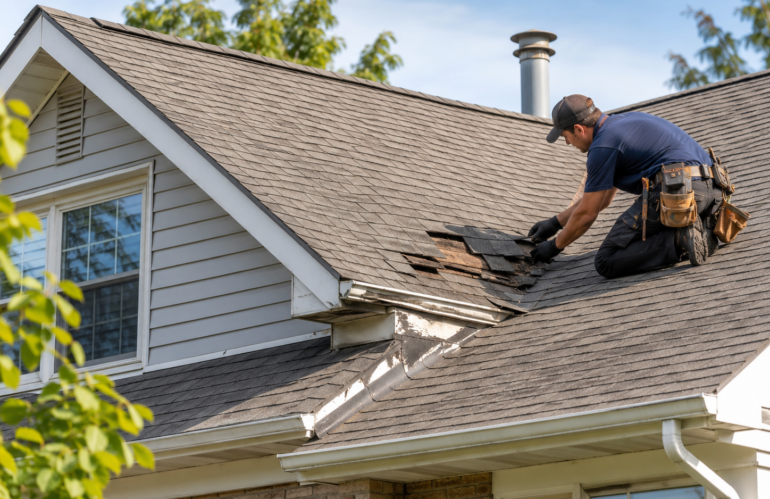
Most homeowners assume a handful of missing shingles means they need a full replacement. They are usually wrong. But a few missing shingles on a 25-year-old roof with widespread granule loss and spongy decking? That is a completely different situation. The roof repair vs. replacement question is not answered by visible damage alone. It is answered by the age of the roof, the scope of underlying damage, and an honest look at what each option actually costs over the next 10 to 15 years. Here is the framework Northern Utah homeowners use to make the right call.
Roof Repair vs. Replacement: Quick Decision Guide
Repair when: damage is localized to one section, your roof is under 15 years old, and the underlying decking and structure are sound.
Replace when: damage covers more than 25 to 30 percent of the roof surface, the roof is at or past its expected lifespan, or there is widespread underlayment failure, structural damage, or recurring leaks in multiple areas.
Signs Your Roof Needs a Repair, Not a Replacement
A repair is almost always the right call when the damage is isolated and the rest of the roof is in good shape. These situations favor repair over full replacement:
- Missing or cracked shingles in a single area. A storm-damaged section of a few shingles, or a cracked course near a valley or ridge, can be matched and replaced without touching the surrounding surface, provided the material is still available and the rest of the roof has life remaining.
- Flashing failure. Flashing around chimneys, skylights, and pipe penetrations deteriorates faster than shingles. Reflashing a chimney or resealing a skylight penetration is a targeted repair that should not require touching the rest of the roof.
- A small leak with a clear, localized source. If an inspection traces a leak to a specific failed sealant point or a single damaged shingle course, targeted repair is appropriate and cost-effective.
One useful benchmark: if the repair cost is less than 25 to 30 percent of what a full replacement would cost, and the roof has seven or more years of remaining life, a repair almost always wins on value.
Signs You Need a Full Roof Replacement
These indicators shift the calculation clearly toward replacement:
The roof is 20 to 25 years old. Asphalt shingles have a typical lifespan of 20 to 30 years, but Northern Utah’s freeze-thaw cycles and intense UV exposure tend to push that toward the lower end. A roof approaching 20 years with one storm-damaged section is a replacement candidate regardless of how localized the visible damage appears. Our guide on how to determine your roof’s age can help if you are unsure when your current roof was installed.
Widespread granule loss. Granules protect the asphalt mat from UV degradation. When you see patches of bare black mat across multiple sections, the shingles are nearing end of life and no surface repair will meaningfully extend the roof’s service.
Sagging or spongy areas. Soft spots when walking the roof indicate rot or structural failure in the decking beneath the shingles. No surface repair fixes this. Decking replacement is required, which typically makes a full replacement the more economical path.
Multiple active leaks or recurring leaks in different areas. If you have patched the same area twice and a new leak appears elsewhere, you are treating symptoms of a failing system. At this point, how often your roof should be replaced is no longer a future question. It is today’s question.
The Factors That Tip the Scale
Roof Age
Age is the single most reliable predictor of which option makes financial sense. A 10-year-old roof with storm damage is a strong repair candidate. The same damage on a 22-year-old roof almost always makes replacement the better investment: you get a warrantied repair and a fresh lifespan rather than a patched surface on material that is already in its final years.
Insurance Coverage
If storm-related hail and wind damage covers a significant portion of your roof, your homeowners insurance may cover replacement costs, minus your deductible, regardless of whether a repair was technically possible. In these cases, accepting a repair when the insurer would pay for a replacement leaves money on the table. A qualified contractor can help you understand what inspection documentation needs to show to support a full replacement claim. If you face a situation requiring immediate response, emergency roof repair is available for urgent stabilization while your claim is processed.
Cost Comparison
A straightforward repair runs $300 to $1,500 for most localized issues. A full replacement on a typical Utah single-family home runs $8,000 to $18,000 depending on size, slope, and materials. If your roof has five or fewer years of useful life remaining, the math often favors replacement even without major damage: you avoid an emergency replacement at a less convenient time and potentially at higher cost when materials or contractor availability are constrained.
The right answer to the repair vs. replacement question is not always obvious from a ground-level view or a homeowner’s walkthrough. The best starting point is a professional inspection that documents the actual condition of shingles, decking, underlayment, and flashing, not just what is visible from the street. Elite Services & Roofing offers thorough inspections for Ogden and Northern Utah homeowners.
Request a free quote and get the information you need to make the right call with confidence.
Frequently Asked Questions
Can I repair just part of my roof?
Yes. Partial repairs and partial replacements (replacing one slope or section) are both common approaches. The key is ensuring the repaired or replaced section integrates properly with the existing roofing system and that the remaining sections have enough useful life to justify the approach. A professional inspection will identify whether a partial approach makes sense for your specific situation.
How long does a roof repair take compared to a full replacement?
Most localized repairs take a few hours to one day. A full residential roof replacement typically takes one to three days depending on the size and complexity of the roof. Both require dry weather conditions for proper installation and sealant adhesion.