
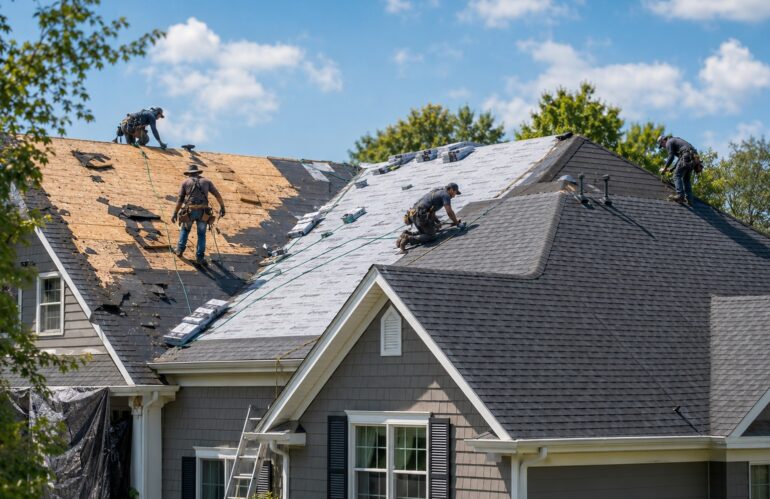
When homeowners ask how long does it take to replace a roof, the number is rarely what they actually want. What they want to know is how long the driveway will be blocked, whether the dog can go outside, and whether they need to burn a vacation day. The honest answer is that most northern Utah roof replacements are a one day job, with a real possibility of stretching into a second or third day. Below is the full timeline, hour by hour on day one, plus every variable that adds time and what happens when the weather turns halfway through.
QUICK ANSWER
Most residential roof replacements take one to three days. A typical 2,000-square-foot asphalt shingle roof is torn off and reinstalled in a single day by a full crew. Steep pitches, multiple layers, metal panels, or unexpected decking rot extend the job to three or four days.
Day one, hour by hour
This is a standard single day asphalt replacement on a walkable pitch with one existing layer. Times shift with crew size and daylight, but the sequence does not change.
- 6:30 to 7:00 a.m. Materials and dumpster arrive. Shingles are usually delivered the day before and loaded onto the roof or staged in the driveway. The dumpster gets positioned as close to the tear-off side as the driveway allows.
- 7:00 to 7:30 a.m. Property protection. Tarps go over landscaping, decks, AC units, and pool areas. Plywood leans against siding on the drop side. This step is a fair proxy for how the rest of the day will go, and it is worth watching.
- 7:30 to 11:00 a.m. Tear-off. The loudest stretch of the day. Old shingles, felt, and nails come off down to bare decking, one slope at a time so the house is never fully open. This is when the hammering and scraping are constant overhead.
- 10:00 a.m. to noon. Deck inspection and repairs. With the deck exposed, the crew checks for soft spots, rot, and delamination. Anything bad gets cut out and replaced. This is the one point in the day where the price can legitimately change, and you should be reachable for it.
- 11:00 a.m. to 1:00 p.m. Underlayment and ice barrier. Ice and water shield goes down at the eaves, in the valleys, and around penetrations, then synthetic underlayment across the field. In our climate this layer matters as much as the shingles above it.
- Noon to 4:00 p.m. Shingles, flashing, and vents. Starter course, then field shingles up each slope, with step and counter flashing at walls and chimneys and new boots on every pipe. Ridge vent goes on last.
- 4:00 to 6:00 p.m. Cleanup and walkthrough. Magnetic rollers over the driveway, lawn, and street, tarps pulled, gutters cleared of debris. Then a walk of the property with you before the crew leaves.
What turns a one day job into a three day job
Every added day traces back to one of these five things. A good estimator can predict four of them from the ground before you sign anything.
- Multiple existing layers. Two or three layers of shingles roughly double or triple tear-off time and dumpster volume. Older Ogden and Layton homes very often have two. Our shingle removal service page explains how that phase is handled.
- Steep pitch. Anything above about 7:12 requires roof jacks, harnesses, and slower movement. A steep 2,000 square foot roof can take twice the labor hours of a walkable one.
- Decking rot. Usually the surprise. If a meaningful percentage of the deck needs replacing, the sheathing has to be sourced, cut, and fastened before any underlayment goes down. This alone can add a full day.
- Material type. Standing seam metal panels are measured, cut, and fastened individually and typically run three to five days on a residential roof. Tile and slate run longer still. Our metal roofing page covers what that installation involves.
- Complex roof geometry. Dormers, valleys, skylights, multiple chimneys, and low-slope transitions all add flashing detail work that does not scale with square footage.
What it is actually like to be home that day
Plan for a loud, busy, temporarily inconvenient day rather than a disruptive week.
- Noise. Constant impact overhead from roughly 7:30 a.m. until late afternoon, with the tear-off portion being the worst. It carries through the whole house, not just upstairs.
- Vibration. Expect pictures to shift and light fixtures to rattle. Take fragile wall art down and cover anything stored in the attic, since decades of dust comes loose during tear-off.
- Parking. Move every vehicle out of the driveway the night before. The dumpster and material truck need the space, and nails in the driveway are a real risk before final cleanup.
- Pets and kids. Most homeowners send both elsewhere for the day. Dogs in particular do not tolerate eight hours of overhead impact well.
- Access. The crew needs gate access to the full perimeter and will be moving ladders around the house all day.
You do not have to be home the entire time, but you should be reachable by phone, especially late morning when the deck is exposed. We cover this in more detail in our walkthrough of the roof replacement process.
What a weather delay actually means
August through October is peak install season along the Wasatch Front for a reason: dry days, workable temperatures, and enough warmth for shingle sealant to activate. Even then, afternoon thunderstorms happen.
A responsible crew never tears off more roof than it can dry in and cover before weather arrives. If a storm moves in mid-job, the exposed area is covered with underlayment or tarped and mechanically fastened, and work resumes the next dry day. Your house is not left open overnight. What a delay usually costs you is a day, not water damage.
The other weather variable is cold. Below roughly 40 degrees, asphalt shingle sealant strips will not bond on their own, which is why late-season installs are hand sealed and why we push homeowners to book before the first hard freeze.
Booking lead times, and how to get on this season’s schedule
Lead times in Weber and Davis counties stretch through the fall. In a normal August you might wait one to two weeks. After a hail or wind event, every reputable local crew books out four to six weeks within days, because the entire neighborhood calls at once.
- Get the estimate early, even if you are not ready. A written estimate holds your material pricing and puts you in the queue.
- Ask for the scheduling window in writing. A specific week is a reasonable ask. A specific date three weeks out is not, because weather moves everyone.
- Know your material lead time. Stock architectural shingles are usually on hand. Special order colors and metal panels add one to three weeks before day one can even be set.
- Book before October. Once overnight lows sit below freezing, installs get slower and the calendar gets tighter.
We schedule installs across Weber, Davis, Morgan, and Summit counties. You can see the full coverage list on our service areas page.
Request a Scheduling Window for This Install Season
Frequently Asked Questions
How long does roof replacement take on an average house?
A 2,000 square foot asphalt roof with one existing layer and a walkable pitch is typically torn off and reinstalled in a single day by a full crew. Larger, steeper, or multi-layer roofs run two to four days.
Should I stay home during roof replacement?
You do not need to be home all day, but you should be reachable by phone, particularly late morning when the decking is exposed and any rot is discovered. Many homeowners come out for the morning start and the end of day walkthrough.
Can a roof be replaced in the rain?
No. Tear-off stops before weather arrives and any open area is dried in or tarped and fastened. Work resumes on the next dry day, so a storm generally costs you a day rather than causing damage.
How long does a metal roof take to install?
Plan on three to five days for a residential standing seam system. Panels are measured and cut to each slope and fastened individually, which is slower than laying shingle courses.
What is the best time of year to replace a roof in Utah?
Late summer through early fall. Temperatures are warm enough for shingle sealant to bond on its own, precipitation is low, and the work finishes before snow load and ice dam season begin.