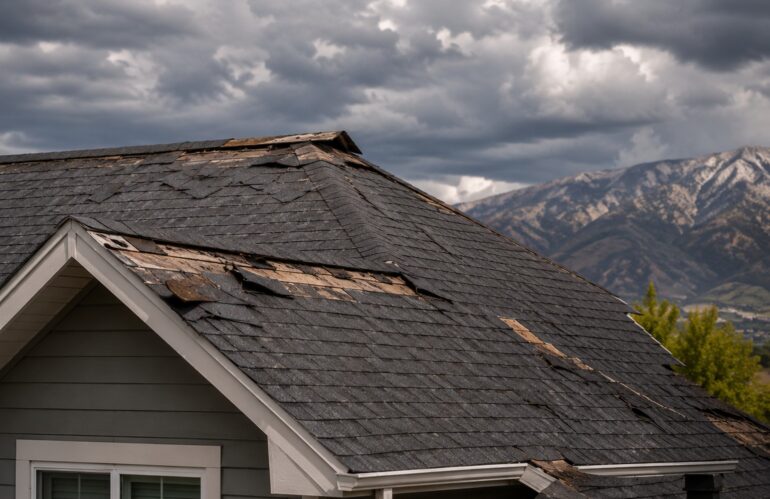
Anyone who has lived along the Ogden bench through a February east wind event knows the sound. What does wind damage look like on a roof afterward is a harder question, because the honest answer is that the worst of it is invisible from the ground. Missing shingles in the yard are the obvious version. The expensive version is a sealed roof that quietly stopped being sealed. Northern Utah canyon winds are a distinct hazard, and this is what they actually do to a roof.
QUICK ANSWER
Wind damage shows up as lifted, creased, or missing shingles, usually starting along roof edges, ridges, and corners where uplift pressure is highest. Look for exposed nail heads, torn flashing, granule loss in gutters, and shingles that no longer lie flat. A crease across a shingle means the seal has broken permanently.
Why damage always starts at edges, ridges, and rakes
Wind does not push a roof down. It pulls it up. As air moves across a sloped surface it accelerates and pressure drops above the roof, creating lift, the same principle that gets an aircraft off a runway. That lift is not distributed evenly.
- Corners take the highest pressure. Wind separating around a building edge creates vortices that concentrate uplift at roof corners, often at two to three times the pressure on the open field of the roof.
- Rakes and eaves are next. Perimeter edges have air moving underneath the shingle course as well as over it, which is exactly the condition that peels a roof.
- Ridges take direct pressure change. Ridge caps sit at the point of maximum velocity and are frequently the first component to go.
- The field is usually last. Damage in the middle of a slope generally means the perimeter already failed and the wind got underneath, or the shingles were never properly sealed.
This is why an inspection that only looks at the middle of the roof from a ladder tells you almost nothing useful.
Creased shingles: the failure you cannot see from the ground
This is the single most important thing on this page. When wind lifts a shingle and drops it back, the shingle usually returns to roughly its original position. It looks fine. But two things have permanently changed.
- The adhesive seal strip is broken. Asphalt shingles bond to the course below with a heat activated sealant strip. Once that bond breaks, it does not re-form. The shingle is now loose in every subsequent wind event.
- The shingle itself is creased. Folding an asphalt shingle back on itself fractures the mat along the crease line, the same way folding cardboard does. Water follows that fracture.
From the driveway, a creased shingle is invisible. From the roof it appears as a faint horizontal line across the shingle face, often with a slightly lighter color where granules cracked loose along the fold. This is what a real wind inspection is looking for, and it is why photographs matter so much in a claim.
Wind speeds, shingle ratings, and what canyon events do
Shingles carry a wind rating from testing, but that rating assumes correct installation, full sealing, and a new roof.
- Standard three-tab shingles: 60 mph rated. Realistically much less once the roof has aged and seals have weakened.
- Architectural shingles: 110 to 130 mph rated. The higher figures generally require an enhanced six nail pattern and correct starter strip at the perimeter.
- Ogden and Weber County east wind events regularly reach 60 to 80 mph, with recorded gusts along the bench and through the canyon mouths well above that. These are not hurricanes, but they are sustained, directional, and they arrive every winter.
The compounding factor is age. A ten year old roof has partially degraded sealant, and cold weather makes asphalt brittle. A wind that a new roof shrugs off can break seals across an entire slope of an older one. Correct fastening is what separates the two, which is why we cover nailing pattern and starter course in our roof installation and repair work.
What to look for after a wind event
- Shingles that no longer lie flat. Any lifted, wavy, or raised edge means a broken seal, even if nothing is missing.
- Exposed nail heads. Visible fasteners mean the shingle above shifted or tore free. Every exposed nail is an open hole in your roof deck.
- Missing ridge caps. Often the first casualty and the easiest to spot from the ground.
- Shingle fragments in the yard or against the fence line. Walk the downwind side of the property. This is frequently the first hard evidence homeowners find.
- Torn or lifted flashing. Wind gets under drip edge and step flashing at walls. Our guide to roofing flashing shows what should be tight.
- Granule accumulation in gutters and splash blocks. Wind driven debris and shingle movement both strip granules.
- Damage to the fence, gutters, or siding. Independent evidence that a wind event of real force hit your specific address, which matters for a claim.
Why one lifted shingle becomes a February leak
A broken seal in October is not a leak in October. Rain runs down the roof surface and over the top of a loose shingle without much trouble. Winter is different.
Snow sits on the roof, melts against a warm deck, and that meltwater runs down under gravity until it hits the eave, where it refreezes. Water backs up behind that ice, and now it is sitting still against your roof rather than running off it. A shingle that is no longer sealed offers no resistance to standing water working sideways and upward underneath it. That is the mechanism behind the great majority of midwinter ceiling stains we get called about, and it started as an unrepaired lifted shingle in the fall.
It is also why we push hard on getting wind damage repaired before the first sustained snow rather than waiting to see if it leaks.
Documenting the storm date for a claim
Wind claims turn on your ability to tie damage to a specific dated event. Do this within a week.
- Record the date and approximate time of the event. Local news coverage and National Weather Service records for Ogden, Layton, and the canyon corridors are all usable corroboration.
- Photograph everything from the ground. Debris in the yard, downed fence sections, shingle fragments, gutters, and any visible roof damage. Keep the original files with their timestamps intact.
- Get a professional inspection with photos of the roof surface. Creased shingles are the evidence that matters most and they cannot be documented from the ground.
- Report promptly. Utah policies require timely notice, and delay is the most common reason a legitimate wind claim runs into trouble. Our post on homeowners insurance coverage for snow and wind damage covers what carriers typically pay for.
If shingles are actively missing and weather is coming, that is a same-day problem rather than a scheduling problem. See emergency roof repair for what we can get tarped and secured quickly. We work throughout Ogden and the surrounding communities.
Request a Free Wind-Damage Inspection After a Named Wind Event
Frequently Asked Questions
What is considered wind damage to a roof?
Lifted, creased, torn, or missing shingles, exposed fasteners, displaced ridge caps, and torn flashing. A broken adhesive seal counts as damage even when nothing is missing, because the shingle can no longer resist water or the next wind event.
How much wind damage does it take to replace a roof?
It depends on distribution rather than count. Damage isolated to one slope or a few ridge caps is usually repaired. Broken seals and creasing spread across multiple slopes generally support replacement, since individually resealing a whole roof is not practical.
Does insurance cover wind damage to a roof?
Wind is a covered peril on most standard Utah homeowners policies. Coverage usually applies to sudden damage from a specific event, not to gradual wear, which is why documenting the storm date matters so much.
How fast does wind have to be to damage shingles?
Aging three-tab shingles can break seals in sustained winds around 45 to 60 mph. Properly installed architectural shingles are rated to 110 mph or higher, though real world performance drops as sealant ages and temperatures fall.
Can I repair wind damage myself?
Replacing a few ridge caps is within reach for some homeowners, but resealing a lifted shingle with roofing cement is a temporary fix that often makes a later claim harder. Creased shingles need replacement, not sealing.