
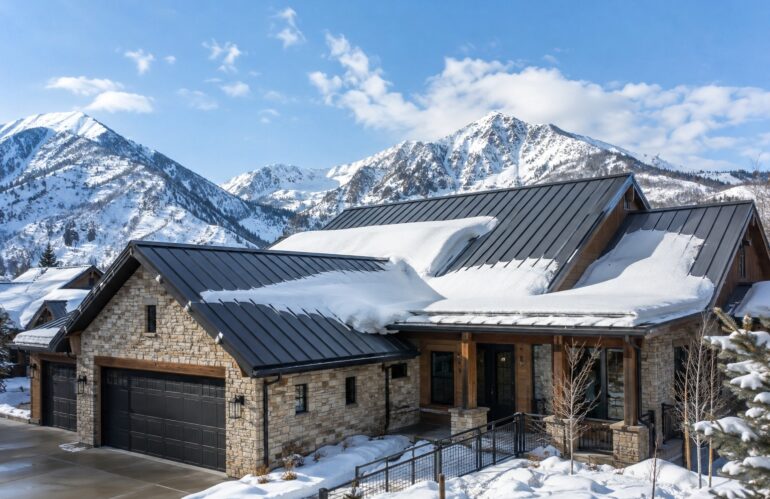
How long does a metal roof last is a question with an unusually satisfying answer: 40 to 70 years, which is two to three times what an asphalt shingle roof gives you. The more useful question for a homeowner in Weber, Davis, or Summit County is what determines where in that range your roof lands, because a metal roof installed without attention to snow load, fastener quality, and snow guard placement can underperform badly. Snow is what makes metal an excellent choice here, and snow is also what punishes a bad installation. Here is how the numbers actually work.
QUICK ANSWER
A properly installed metal roof lasts 40 to 70 years, roughly two to three times longer than asphalt shingles. Standing seam systems with concealed fasteners last longest because there are no exposed screws or gaskets to fail. In heavy snow climates, lifespan depends heavily on correct snow guard placement and fastener quality.
Lifespan by system, and why the spread is so wide
Metal roofing is not one product. The three residential systems have genuinely different service lives, and the difference comes down to one thing: whether the fasteners are exposed to weather.
- Standing seam, 50 to 70 years. Panels lock together at raised vertical seams and are attached with concealed clips. Nothing that holds the roof down is exposed to UV, water, or thermal cycling. The clips also allow panels to expand and contract freely, which matters enormously in a climate that swings 60 degrees in a day.
- Exposed fastener panel, 25 to 40 years. Screws driven through the face of the panel into the deck, each with a rubber washer. Considerably cheaper, and very common on shops, barns, and outbuildings across Weber and Morgan counties. The washers are the weak point.
- Metal shingle or stone coated steel, 40 to 50 years. Interlocking panels that mimic shingle or tile appearance. Good longevity, and often the right answer where an HOA or a historic streetscape rules out standing seam.
- Aluminum and copper, 50 to 100 years. Aluminum resists corrosion completely and is excellent near heavy road salt exposure. Copper outlasts everything and is priced accordingly.
If you are still deciding between materials rather than between metal systems, our comparison of metal versus shingle roofing covers the tradeoff directly.
What actually fails first
The steel panel itself is almost never what ends a metal roof’s life. Four other things are, and all four are installation and maintenance variables rather than material properties.
- Fastener washers, on exposed fastener systems. The neoprene or EPDM washer under each screw head degrades under UV and compresses through thermal cycling. Expect to re-screw an exposed fastener roof at roughly year 15 to 20. Budget for it and the roof gets to 40. Skip it and it leaks at 20.
- Panel movement and fastener elongation. Metal expands and contracts substantially with temperature. On exposed fastener systems the screw holes gradually elongate, which is why concealed clip systems last so much longer here. Our note on what gauge metal is best for residential roofing covers why panel thickness matters to this.
- Coating failure. A Kynar 500 or PVDF finish holds color and integrity for 30 to 40 years. Cheaper polyester finishes chalk and fade in 10 to 15, and once the coating goes, the substrate is exposed. The coating specification is one of the most consequential and least discussed line items in a metal roofing quote.
- Penetration flashing and sealants. Pipe boots, curb flashings, and seam sealants have service lives measured in decades, not lifetimes. On a 60 year roof, expect to re-detail penetrations at least once.
The pattern is clear: metal roofs rarely wear out, they get neglected. A roof inspected every few years and re-screwed on schedule genuinely reaches the top of its range.
Why metal sheds snow, and why that is a hazard without snow guards
A smooth, slick metal surface does not hold snow the way a granulated shingle does. As soon as sun or attic heat warms the panel enough to create a thin film of water underneath, an entire slope of accumulated snow can release at once.
That shedding is genuinely good for the roof. It removes structural load, and it largely eliminates the melt-refreeze cycle at the eaves that creates ice dams on shingle roofs. It is one of the strongest arguments for metal in northern Utah.
It is also a real hazard. A slope carrying two feet of wet snow can release several thousand pounds in a few seconds, and it does not land gently. We have seen released snow destroy gutters, crush deck railings, flatten shrubs, bury a walkway to waist depth, and take out a parked car. On a commercial building it is a liability question, not just a maintenance one.
Snow guard placement over entries, walkways, and driveways
Snow guards, sometimes called snow retention or snow fences, hold snow on the roof so it melts and drains gradually instead of releasing in a slab. On a metal roof in this climate they are not an accessory. They are part of the system.
- Required over every entry, walkway, driveway, and patio. Anywhere a person, a vehicle, or a gas meter sits below a metal slope.
- Also over lower roof sections. Snow released onto a lower roof concentrates load in one spot and can damage the roof below it.
- Layout should be engineered, not eyeballed. Placement depends on ground snow load, roof pitch, panel length, and the retention product used. Northern Utah ground snow loads vary widely by elevation, and Summit County numbers are far higher than Davis County ones.
- Clamp-on for standing seam, never through the panel. Seam clamps grip the raised seam with no penetration. Any snow guard installed by drilling through a standing seam panel compromises both the waterproofing and the panel’s ability to move.
- Multiple rows on long or steep slopes. A single row at the eave is the most common design error, because it concentrates the entire slope’s load at one line.
Retrofit is possible on standing seam, since clamps attach to the seams without penetrating, so an existing roof missing guards can usually be corrected. See our metal roofing page for the systems we install.
Installing metal over existing shingles, and when code allows it
Metal can be installed over one existing layer of shingles in many cases, and it is a genuine cost saver when conditions are right. It is also the source of several avoidable problems.
When it works
- Only one existing layer, with the deck underneath in known good condition.
- The existing shingles lie reasonably flat, since telegraphing through the panel is a real cosmetic issue.
- A slip sheet or furring strips are installed to separate the metal from the granulated surface, preventing abrasion and allowing ventilation.
- The local jurisdiction permits it. Rules vary across Weber, Davis, Morgan, and Summit counties, and this is a question for the permit desk rather than the contractor.
When it does not
- Two existing layers, which is where code generally draws a hard line.
- Any suspicion of decking rot, since covering it hides a problem that will not stop progressing.
- Structural load concerns on older homes, though metal is lighter than most people assume at roughly 1 to 1.5 pounds per square foot.
Our honest recommendation is usually to tear off. You get to inspect and repair the deck, install proper ice and water shield at the eaves, and start the 60 year clock with nothing unknown underneath. On a roof meant to outlive your ownership of the house, that is worth the extra cost.
Warranty length versus real service life
Metal roofing warranties are marketed hard and are frequently misread. There are three distinct warranties and they cover different things.
- Substrate or perforation warranty, 20 to 40 years. Covers the steel rusting through. Very rarely invoked.
- Finish warranty, 25 to 40 years. Covers chalking, fading, and coating failure. This is the one that most affects how the roof looks in year 25, and it is where Kynar 500 and PVDF finishes separate themselves from cheaper coatings.
- Workmanship warranty, 2 to 25 years. From the installer, not the manufacturer, and it covers the thing most likely to actually go wrong. It is only as good as the company standing behind it.
Note that none of these is a service life guarantee, and most prorate heavily after the first decade. A 50 year warranty from a company that has been in business for three years is a marketing document. A 10 year workmanship warranty from an established local company is worth considerably more.
Cost per year of service versus asphalt
This is the calculation that makes metal make sense, and it is worth doing with your own numbers rather than accepting a sales version of it.
Take a 2,000 square foot roof. Architectural asphalt at $9 per square foot is roughly $18,000 for 25 years of service, or about $720 per year. Standing seam at $16 per square foot is roughly $32,000 for 55 years, or about $580 per year. Metal wins on the arithmetic even before you account for avoided tear-off costs on the second and third shingle roofs, possible insurance discounts for impact resistant roofing, and better winter performance.
Where the arithmetic does not decide it is cash flow and time horizon. If you expect to sell within five years, you will not personally recover the premium, though the roof does help the sale. If the up front number is the constraint, our financing page and our post on how to pay for a new roof lay out the options. And if you want to keep the finish looking new, our guide to cleaning a metal roof covers the maintenance side.
Request a Metal Roofing Consultation and Quote
Frequently Asked Questions
How long does a metal roof last in Utah?
A properly installed standing seam metal roof lasts 50 to 70 years in northern Utah. Exposed fastener panels run 25 to 40 years and typically need re-screwing around year 15 to 20 to reach the upper end.
Can you put a metal roof over shingles?
Often yes, over a single existing layer, with a slip sheet or furring strips and local permit approval. It is not advisable over two layers or where decking condition is unknown, and a full tear-off is usually the better long term choice.
Do I need snow guards on my metal roof?
Yes, anywhere snow can release onto an entry, walkway, driveway, patio, gas meter, or lower roof section. Metal sheds snow in slabs, and an unguarded slope can drop thousands of pounds at once.
What are snow guards on roofs?
Devices mounted on the roof surface that hold snow in place so it melts and drains gradually rather than sliding off in a sheet. On standing seam they clamp to the seams without penetrating the panel.
Is a metal roof cheaper than shingles?
Not up front, at roughly two to three times the installed cost. Over a full service life the cost per year is usually comparable or better, since one metal roof can outlast two or three asphalt roofs.
Does a metal roof prevent ice dams?
It substantially reduces them, because snow sheds before the melt and refreeze cycle can build a dam at the eaves. It does not eliminate the underlying cause, so attic air sealing and ventilation still matter.