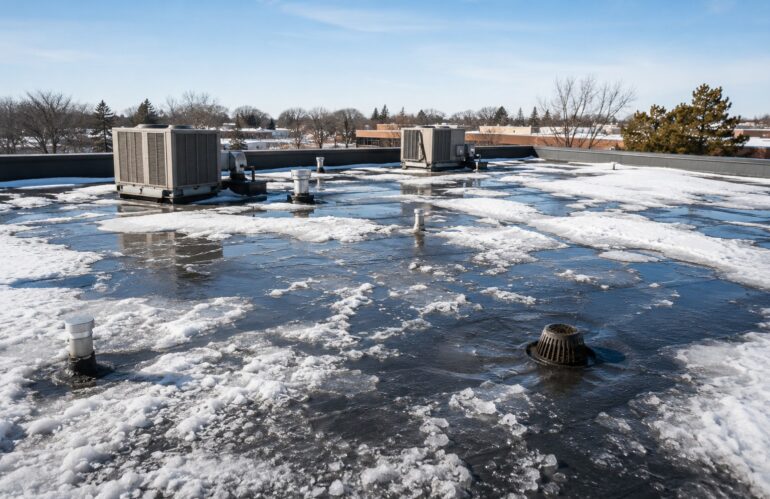
A flat commercial roof does not shed. That single fact drives everything that follows. Where a steep residential roof sends snow and meltwater off the edge under gravity, a low slope membrane roof holds whatever lands on it until it either drains or evaporates, and in a northern Utah winter it does neither for months. Understanding how snow and ice impact flat commercial roofs is mostly about three things: how much weight is up there, whether water can get off, and what repeated freezing does to the seams holding your building dry.
QUICK ANSWER
Snow and ice threaten flat commercial roofs through structural load, drainage failure, and freeze-thaw damage. Wet snow can weigh over 20 pounds per cubic foot, and blocked drains or scuppers cause ponding that refreezes and stresses seams. Most winter membrane failures begin at seams, flashings, and drain penetrations.
Snow load math, and when removal becomes necessary
Snow weight varies enormously with moisture content, which is why depth alone tells you very little. Use weight, not inches.
- Fresh light snow: about 5 to 7 pounds per cubic foot. Ten inches adds roughly 5 pounds per square foot.
- Settled or packed snow: 12 to 18 pounds per cubic foot. The same ten inches now weighs double.
- Wet or rain-saturated snow: over 20 pounds per cubic foot. This is the dangerous category, and it is what a January rain-on-snow event produces along the Wasatch Front.
- Ice: about 57 pounds per cubic foot. An inch of ice weighs roughly as much as a foot of fresh snow.
Most commercial low slope roofs in this region are designed for a ground snow load in the 30 to 60 pound per square foot range depending on elevation, with Summit County substantially higher than Davis County. Your structural drawings state the actual design figure, and that number is worth having on file before winter rather than looking for it during a storm.
Removal becomes necessary when accumulated weight approaches the design load, when a rain-on-snow event is forecast onto an existing snowpack, when drifting has concentrated depth against a parapet or a taller adjacent wall, or when you see any interior warning sign: sagging deck, new cracks in interior finishes, doors that suddenly stick, or audible creaking. Drifting is the most underestimated of these, because a roof can be within design load overall while a drift against a parapet is well over it locally.
Drainage: internal drains, scuppers, and tapered insulation
A flat roof is not actually flat. It is built with a slight slope, usually a quarter inch per foot, achieved with tapered insulation directing water to drainage points. When drainage fails, everything else on this list gets worse at once.
- Internal drains sit at the low points and carry water through the building. They clog with leaves and debris, and in winter the standing water above a clogged drain freezes into a plug that no amount of warm afternoon will clear.
- Scuppers are openings through the parapet that discharge water at the edge. They are the most common freeze point on a commercial roof, because they sit at the coldest part of the assembly with exposure on both sides.
- Overflow drains and secondary scuppers are the backup system, set a couple of inches above the primary. If you have never seen water come out of one, that is good, but they still need to be verified clear.
- Tapered insulation creates the slope. Where it has been compressed, saturated, or poorly detailed around a curb, water sits regardless of what the drains are doing.
The single highest value maintenance action before winter is clearing every drain, scupper, and overflow, and confirming water actually moves to them. Everything downstream of that is damage control. Our low slope roofing page covers the systems involved.
Ponding and freeze-thaw stress on membrane seams
Ponding is defined as water remaining on a roof more than 48 hours after precipitation ends. In summer it is a durability problem. In winter it becomes a structural one.
- Water pools at a low spot or a blocked drain.
- It freezes, expanding roughly 9 percent in volume. That expansion is not gentle. It pushes laterally and downward against everything at the edge of the pool.
- The ice works into seams and flashing laps, prying at any spot where adhesion is less than perfect.
- It thaws, and the water penetrates deeper into the opened seam.
- The cycle repeats. Northern Utah crosses freezing repeatedly in a single day through late winter, so a roof may run this cycle a hundred times a season.
There is also a feedback loop worth knowing. Ponded water causes slight deck deflection, deflection deepens the pond, and the deeper pond holds more weight. On an older building with a marginal deck, that is how ponding becomes a structural conversation.
How TPO, EPDM, and modified bitumen fail differently in cold
The three common low slope membranes all perform acceptably in cold, but they fail in characteristic ways and it helps to know which one is over your head.
TPO
Heat welded seams are extremely strong when correctly made, and TPO’s reflective white surface is an advantage in summer and a mild disadvantage in winter, since it sheds less snow through solar gain. Failures concentrate at poorly welded seams and at penetration details rather than in the field. Cold also makes the sheet stiffer, so repairs made in winter need proper surface prep and temperature to bond. Our primer on what TPO roofing is covers the material in more depth.
EPDM
Rubber membrane stays flexible in extreme cold, which is a real strength. Its seams are adhesive rather than welded, and adhesive seams are the weak point under freeze-thaw and prolonged saturation. Older EPDM roofs with tape seams should have every lap inspected before winter. The black surface absorbs solar heat and sheds snow better than TPO, which cuts both ways: it also drives more melt-refreeze at cold edges.
Modified bitumen
Multi-ply asphalt based systems are durable underfoot and tolerate snow removal traffic better than single-ply. They become brittle in deep cold, so impact damage during snow removal is the main winter risk, along with granule loss at the surface and splitting at flashing transitions where movement concentrates.
Across all three, the pattern holds: failures begin at seams, flashings, curbs, and drain penetrations, not in the open field. If you want the broader tradeoffs, see our post on flat roof advantages and disadvantages.
Safe snow removal that will not puncture a membrane
More commercial roofs are damaged by snow removal than by snow. The rules are simple and they are non-negotiable.
- Plastic shovels only. No metal edges, ever. A metal blade will cut a single-ply membrane and you will not know until spring.
- Leave two to three inches in place. Removing snow to the membrane guarantees contact damage. The remaining layer is a sacrificial cushion.
- Never chip at ice. If ice is bonded to the membrane, it stays until it melts or a steam crew removes it. Chipping removes membrane along with ice.
- No de-icing salt or chemicals unless the manufacturer specifically approves the product for that membrane. Many chemicals degrade single-ply and corrode metal edge details and drains.
- Remove evenly, and never one area at a time. Clearing half a roof creates an unbalanced load the structure was not designed for, which is a genuine collapse risk.
- Do not pile snow on the roof. Concentrated piles are exactly the load condition to avoid, and they melt into ponding.
- Clear the drains and scuppers first. Otherwise you have simply converted a snow load into a ponding problem.
- Fall protection is required. Parapets are frequently below OSHA guardrail height and are not a fall protection system. Snow hides skylights, curbs, and roof openings entirely.
The pre-winter commercial inspection checklist
Run this in September or early October, before the first storm.
- Clear and test every drain, scupper, and overflow. Run water and confirm it moves.
- Inspect every seam and lap, with particular attention to any previous repair.
- Check all flashings and terminations at parapets, walls, curbs, and expansion joints.
- Inspect every penetration. Vents, HVAC curbs, conduit, skylights, and pitch pockets, which dry out and shrink and are a classic winter leak source.
- Note ponding evidence. Dirt rings and staining show where water sat over the summer, and those areas will hold ice.
- Scan for trapped moisture. Infrared survey identifies saturated insulation that is invisible from the surface and that will freeze and expand.
- Verify the design snow load from the structural drawings and post it with your winter plan.
- Confirm safe roof access and fall protection before anyone needs to go up in a storm.
Our commercial roofing team performs these assessments across Weber, Davis, Morgan, and Summit counties.
Documenting roof condition for property insurance
For a commercial property, documentation is not paperwork. It is the difference between a covered claim and a denied one, because carriers routinely attribute winter losses to deferred maintenance rather than to the storm.
- Keep a dated pre-winter condition report with photographs every year. This establishes that the roof was sound before the event.
- Log all maintenance, including drain clearing, with dates and invoices.
- Photograph snow depth and drift locations during events, with something in frame for scale, and document who performed any removal and by what method.
- Keep membrane warranty documentation accessible. Many manufacturer warranties are void if documented maintenance was not performed.
- Report any loss promptly, and photograph interior damage as well as the roof.
That file costs a few hours a year and it is the most valuable thing you can hand an adjuster in February.
Schedule a Commercial Pre-Winter Roof Assessment
Frequently Asked Questions
How much snow can a flat commercial roof hold?
Most northern Utah commercial roofs are designed for roughly 30 to 60 pounds per square foot depending on elevation. Because wet snow exceeds 20 pounds per cubic foot, weight rather than depth is the number that matters. Check your structural drawings for the design load.
Why do commercial buildings have flat roofs?
Cost per square foot on large footprints, usable space for HVAC and other equipment, simpler construction over wide spans, and easier maintenance access. The tradeoff is that drainage must be engineered rather than provided by gravity.
How do I repair a leaking flat roof in winter?
Emergency measures such as temporary patching can be done cold, but most permanent repairs need surface preparation and temperatures that allow adhesion or welding. The usual approach is to stop active water, document the damage, and schedule a permanent repair.
What is the best material for a flat roof in a cold climate?
EPDM stays flexible in extreme cold and sheds snow well. TPO offers strong heat welded seams and summer energy savings. Modified bitumen tolerates foot traffic during snow removal best. Installation quality at seams and details matters more than the material choice.
Should snow be removed from a flat commercial roof?
Only when load approaches the design figure, when rain is forecast onto existing snowpack, when drifting concentrates depth, or when interior warning signs appear. Remove evenly with plastic tools, leave two to three inches in place, and never chip at ice.