
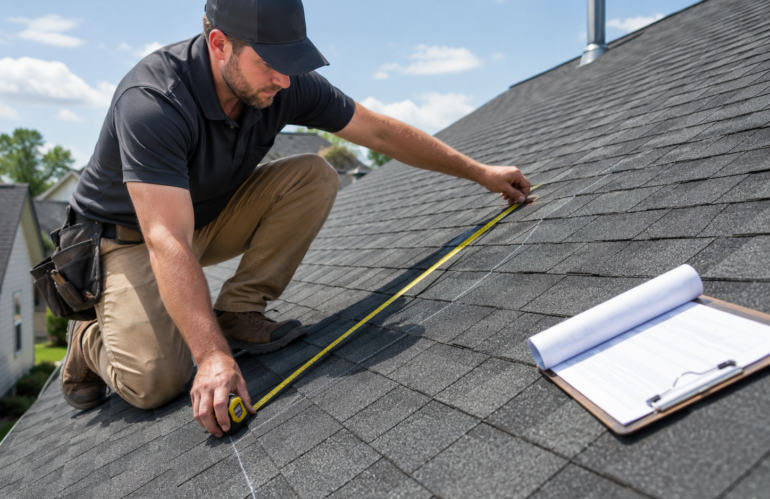
You called a roofer. They walked your roof, climbed down, and handed you a quote: “18 squares of architectural shingles, two layers of underlayment, and new drip edge.” You nodded like you understood. You did not.
Roofing has its own unit of measurement — the square — and it is the number everything else in a quote is built on. Understanding what a roofing square is, how contractors calculate it, and why waste factors matter will not make you a roofer. But it will make you a homeowner who can read a bid, compare estimates, and catch a number that does not add up.
What is a roofing square?
A roofing square is a unit of measurement equal to 100 square feet of roof surface area. It is not a shape — it is a quantity. A 2,000-square-foot roof contains 20 squares of material. Contractors use squares to price labor, order shingles, and calculate underlayment and other materials consistently across any roof shape or pitch.
Why Roofers Use Squares Instead of Square Feet
Square feet is how homeowners think about space. Squares are how the roofing industry orders, prices, and installs materials — and the two numbers are not the same as the floor plan of your home.
Your home might sit on a 2,000-square-foot footprint, but the actual roof surface — the sloped area a roofer has to cover — is larger. A steeper pitch means more surface area per square foot of floor plan, which means more squares of material required. A 1,500-square-foot ranch with a low slope might need 16 squares. A 1,500-square-foot home with a steep cathedral pitch might need 22.
Roofing squares exist because they create a consistent unit of work. One square of three-tab shingles covers the same area regardless of whether it is going on a farmhouse or a colonial. Labor rates, material costs, and disposal fees are all priced per square, which is why that number anchors every roofing estimate.
How Roofing Squares Are Calculated
The basic math is simple. Measure the total roof surface area in square feet, then divide by 100. The result is the number of squares.
Roof surface area (sq ft) ÷ 100 = Number of squares
For a simple gable roof, a contractor measures each rectangular slope separately — length multiplied by width — then adds them together. A roof with two slopes, each measuring 40 feet long by 20 feet wide, has a total surface area of 1,600 square feet, or 16 squares.
Pitch and the Slope Factor
Pitch is where the math gets less obvious. Roof pitch is expressed as a ratio of rise to run — for every 12 inches of horizontal distance, how many inches does the roof climb? A 4/12 pitch rises 4 inches for every 12 inches of run. A 12/12 pitch is a 45-degree slope.
The steeper the pitch, the more actual surface area exists per square foot of floor plan. Contractors apply a pitch multiplier — sometimes called a slope factor — to adjust the flat footprint measurement to the true sloped surface area. A 4/12 pitch carries a multiplier of about 1.054. A 12/12 pitch carries a multiplier of about 1.414. That difference adds up fast on larger roofs.
| Roof Pitch | Rise per 12″ Run | Slope Factor (approx.) |
|---|---|---|
| 3/12 | 3 inches | 1.031 |
| 4/12 | 4 inches | 1.054 |
| 6/12 | 6 inches | 1.118 |
| 8/12 | 8 inches | 1.202 |
| 10/12 | 10 inches | 1.302 |
| 12/12 | 12 inches | 1.414 |
The Waste Factor: Why Your Estimate Is Always More Than the Roof
A clean calculation of roof squares tells you the minimum material needed if every cut were perfect and nothing was wasted. No real roof works that way.
Valleys, hips, ridges, chimneys, and dormers all require cuts. Every cut produces scrap. Experienced contractors add a waste factor to the square count before ordering materials — typically 10 to 15 percent on a straightforward gable roof, and up to 20 percent or more on a complex roof with multiple valleys, dormers, or steep hips.
If a roof measures 20 squares and the contractor applies a 15 percent waste factor, they order 23 squares. The extra material covers cuts, breakage, and matching — and it means you have leftover shingles on hand if a single section needs spot repair years later. Ordering short to save money on materials is a common false economy: a contractor who runs out mid-job either stops work or mismatches the patch.
What One Square of Material Actually Covers
One roofing square covers 100 square feet of finished, installed roof surface. That is true for shingles, underlayment, and most other roofing materials — but the packaging and pricing differ.
Shingles
Three-tab asphalt shingles typically come three bundles to a square. Architectural (dimensional) shingles, which are heavier and more layered, usually require four bundles to cover a square because each bundle covers less area. Premium shingles can run even higher. When you see a roofing estimate listing bundles, divide by the appropriate number for that shingle type to get the square count.
Underlayment
Felt and synthetic underlayment rolls are sold by square as well, though roll sizes vary by product and weight. A standard 15-pound felt roll covers two squares; a 30-pound roll covers one. Synthetic rolls vary by manufacturer. Ice-and-water shield is typically sold by the square foot and priced separately.
Metal Roofing and Tile
Metal roofing panels and clay or concrete tile are also priced per square, but the installation labor per square is higher than asphalt. A 20-square standing-seam metal roof will carry a significantly different labor cost than a 20-square asphalt job — same measurement, different price. This is why comparing estimates on different material types requires looking at the per-square breakdown, not just the total.
How to Read a Roofing Estimate Using Squares
A well-written roofing estimate will state the square count, the material type, the number of bundles ordered, and the waste allowance. Here is what to look for when comparing bids:
- Square count vs. your roof size. If you know your approximate footprint and pitch, a rough square estimate should be in the ballpark. A bid that comes in dramatically lower on squares than another may be underordering material.
- Waste percentage stated explicitly. A contractor who includes a line item for waste is showing their work. One who does not may be underquoting to win the bid and charging for additional materials later.
- Bundles vs. squares. Make sure you can convert between the two for the specific shingle type being used. An estimate listing 60 bundles of architectural shingles represents 15 squares, not 20.
- Labor per square vs. total labor. On larger roofs, per-square labor rates sometimes drop slightly. On complex roofs with steep pitches or many penetrations, they rise. A flat per-square rate applied to a complicated roof is a sign the contractor may not have fully measured it.
The Bottom Line
A roofing square is 100 square feet. Every other number in a roofing quote follows from it: material quantities, waste factors, labor rates, and total cost. Once you know what a square is and how the count is arrived at, a roofing estimate stops being a black box.
If you are preparing for a repair or replacement and want a clear, itemized quote that explains every line, request a free quote from Elite Services and Roofing. We walk you through the square count, the material selection, and the reasoning behind every number before any work begins.
Frequently Asked Questions
How many square feet is a roofing square?
One roofing square equals exactly 100 square feet of roof surface area. It is a unit of measurement used to price and order roofing materials consistently across any roof size or shape.
How many bundles of shingles do I need per square?
It depends on the shingle type. Three-tab asphalt shingles typically require three bundles per square. Architectural (dimensional) shingles usually require four bundles per square because each bundle covers less area. Always confirm the bundle coverage with your contractor or the shingle manufacturer’s spec sheet.
Does a steep roof require more squares than a flat one?
Yes. A steeper pitch means more actual surface area per square foot of floor plan. Contractors apply a slope factor to the footprint measurement to calculate the true sloped surface area. The steeper the pitch, the higher the slope factor, and the more squares of material required.